
The problem with methane
From CNN’s Rachel Ramirez and John Keefe
Methane — the main component of natural gas — is invisible and odorless, and has 80 times more warming power in the near-term than carbon dioxide.
With Earth rapidly approaching the 1.5-degree-Celsius threshold above preindustrial levels, scientists tell CNN that methane emissions need to be reduced fast.
“The fastest way that we might mitigate some of the climate change that we’re seeing already in the short term is by reducing methane,” Charles Koven, a lead author on August’s IPCC report, told CNN. “If we were to reduce methane emissions, it would act to offset one of these sources of warming.”
If the world stopped emitting carbon dioxide tomorrow, Koven said, global temperatures wouldn’t begin to cool for many years because of how long the gas stays in the atmosphere. Reducing methane is the easiest knob to turn to change the path of global temperature in the next 10 years, he said.
Methane can be produced in nature from volcanoes and decomposing plant matter, but it is pumped into the atmosphere in much larger amounts by landfills, livestock and the oil and gas industry.
Read more: Scientists say this invisible gas could seal our fate on climate change
China does “not resist the 1.5 degree target,” says climate envoy at COP26
From Amy Cassidy in Glasgow
China does “not resist” the target of limiting global warming to 1.5 degrees Celsius above pre-industrial levels and it is an “achievable target”, the country’s Special Envoy for Climate Change Xie Zhenhua said Tuesday.
“I do not resist the 1.5 degree target. That is a part of the Paris Agreement goals, actually. Talking about global climate goals needs to be based on rules. Since 1.5 degrees Celsius is a part of the Paris goals, certainly we’re not against this target,” Xie Zhenhua said responding directly to a question from CNN during a press conference at COP26 on why China appears to be resisting what scientists say is the crucial target in preserving a liveable planet.
“What I stress here is that the world needs to focus on how to implement this 1.5 degree Celsius target. Whenever we talk about temperature goals, these are goals for the whole world, not for any individual country,” he added.
Earlier in the conference, Zhenhua said “the world already has consensus” on “what people are now saying, keeping 1.5 degrees within reach”.
The COP26 climate conference in Glasgow has been described as the last chance to secure this goal. The 2015 Paris Agreement — to which China is party — commits countries to keeping global warming “well below 2 degrees Celsius above pre-industrial levels and to pursue efforts to limit the temperature increase even further to 1.5 degrees Celsius,” according to the United Nations Framework Convention on Climate Change, UNFCCC, who brokered the agreement.
“If we are to only focus on 1.5 degrees, it means that we are destroying this consensus among all parties, and many countries are demanding reopening of negotiations. If we are to change the target to only 1.5 degrees Celsius, that will take a lot of time, it will be quite a long process,” he told reporters. “So, what I am saying is that we need to be realistic, to be pragmatic and to correctly interpret the Paris Agreement goals and focus on taking concrete and real actions.”
Zhenhua cited China’s “special development stage” for why the country is currently the world’s biggest emitter of CO2. Developing countries such as China, with a per capita GDP of around $10,000, need more time to achieve carbon neutrality, he added.
China aims to be carbon neutral by 2060 and to peak its greenhouse gas emissions by 2030.
Although the country took a major step in September by promising to stop funding coal-fired power stations abroad, it plans to increase its domestic production. Coal is the most carbon-intensive fossil fuel.
Zhenhua said China’s goal is to “strictly control” coal consumption in the economic period between 2021 and 2025, and to “gradually reduce our coal consumption” between 2025 and 2030.
Speaking seagull on board the SS Planet Titanic
From CNN’s Ivana Kottasova
Some protesters are trying to express their anger and bewilderment about the climate crisis in more creative ways.
Mike Hancock came equipped with an animatronic seagull that is encouraging those heading to the COP26 conference to worry about climate.
“We got a piece of street theatre about the SS Planet Titanic where we sing calming songs while people rearrange their deckchairs,” he said, adding that his seagull’s role is to tell people the inconvenient truth.
“We are not very optimistic about what’s going on here. It would be great if there was success at the COP, but at the moment, we’re heading for the rocks, I am afraid,” he said.

“This is the last generation that can make a difference,” says Maldives environment minister
From CNN’s Vasco Cotovio
The Maldives Environment Minister Aminath Shauna said the current generation is the last one “that can make a difference” and reverse climate change.
“Our generation is the last generation that can make a difference and turn things around,” Shauna said in an interview with CNN’s Lynda Kinkade on Tuesday. “I think there’s still time to do it.”
Shauna went on to say that humanity has all the tools it needs, what’s lacking is the ability to work together.
“We have to agree that we can come together, if we have the political will. And it’s not rocket science to be able to do it,” she explained. “The finance is available, the technology is available, we have knowledge to really do what is needed to prevent a climate crisis.”
Around 100 nations pledge to cut methane emissions by 30%
From CNN’s Vasco Cotovio
Approximately 100 countries have signed on to a global pledge to cut methane emissions by 30%, led by the United States and the European Union.
“This is fantastic,” European Commission President Ursula von de Leyen said Tuesday as she announced the news, explaining that slashing methane emissions will have a quick impact. “Doing that will immediately slow down climate change.”
“We have to act now,” she explained.
kebo88 | slot gacor | situs slot gacor
“We cannot wait for 2050, we have to cut emissions fast and methane is one of the gases we can cut fastest.”
“Cutting back on methane emissions is one of the most effective things we can do to reduce near term global warming and keep 1.5 degrees Celsius. It is the lowest-hanging fruit,” she concluded.
Boris Johnson apologizes to Israel’s energy minister over lack of wheelchair access at COP26
From CNN’s Ingrid Formanek and Luke McGee
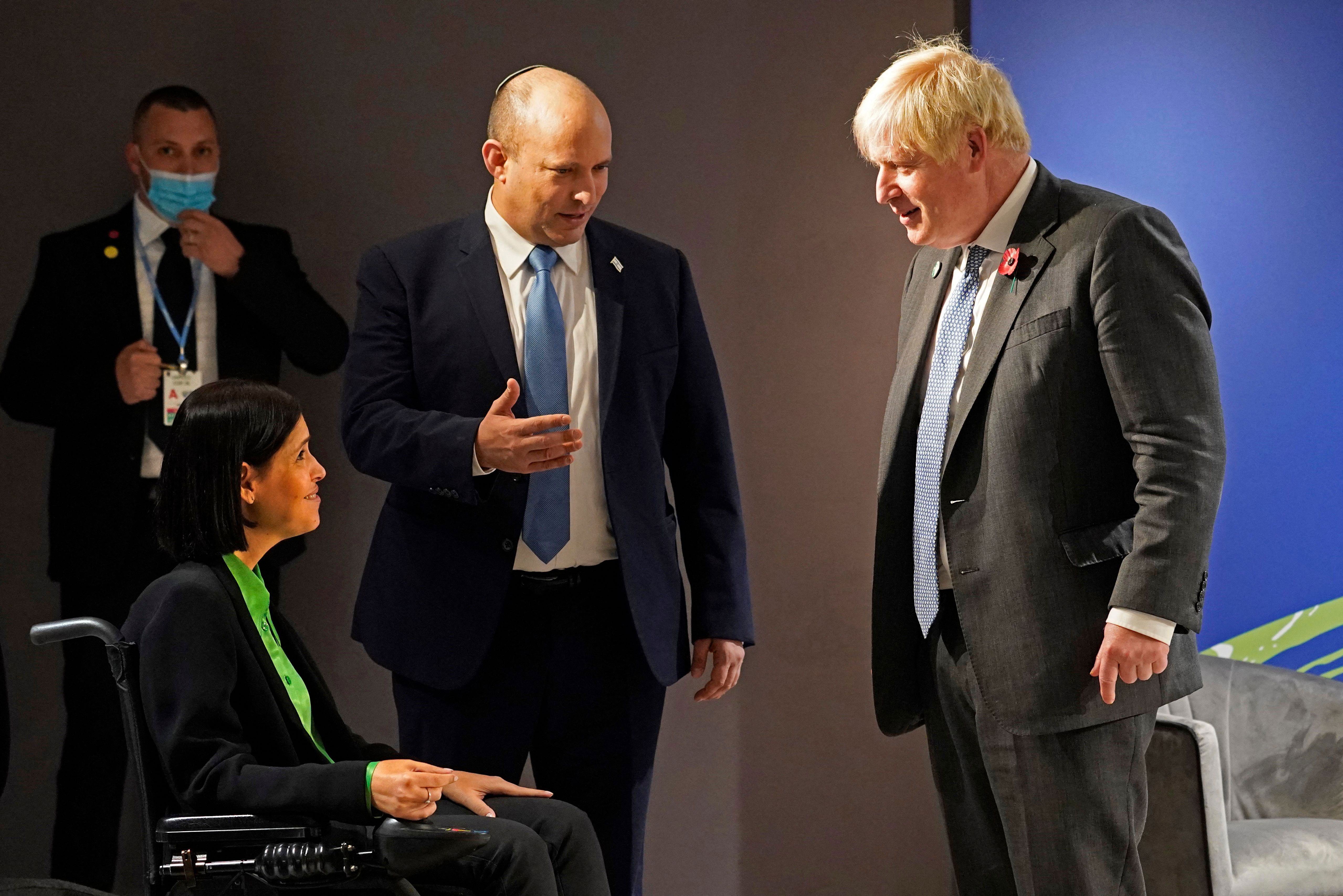
UK Prime Minister Boris Johnson personally apologized to Israel’s Energy Minister, Karine Elharrar, who was unable to attend COP26 on Monday because of the lack of wheelchair access to the venue.
Johnson asked Israeli Prime Minister Naftali Bennett to invite Elhaarrar to join the two prime ministers in a separate meeting Tuesday.
Elharrar, who suffers from muscular dystrophy and uses a wheelchair, was unable to attend Monday’s proceedings and Johnson personally apologized to her for the incident, according to a senior official with the Israeli delegation at COP.
Elharrar traveled to the COP venue in Bennett’s motorcade on Tuesday and was accompanied by the Israeli Prime Minister into the conference, the official said.
Bennett sharply criticized the event organizers for the wheelchair-access issue after Monday’s incident, and had threatened to cancel his appearance at the event Tuesday.
The president of COP, Minister Alok Sharma has repeatedly said that a fully inclusive conference was critical to the success of the climate conference.
Downing Street confirmed to CNN that Johnson had apologized to Elharrar.
“History will judge you”: Climate activists young and old demand action from world leaders
From CNN’s Ivana Kottasová in Glasgow
Climate activists of all ages have descended on Glasgow to demand that world leaders act quickly to combat the climate crisis — but not all are hopeful that COP26 will lead to concrete pledges.
CNN’s Ivana Kottasová has spoken with a few of them:
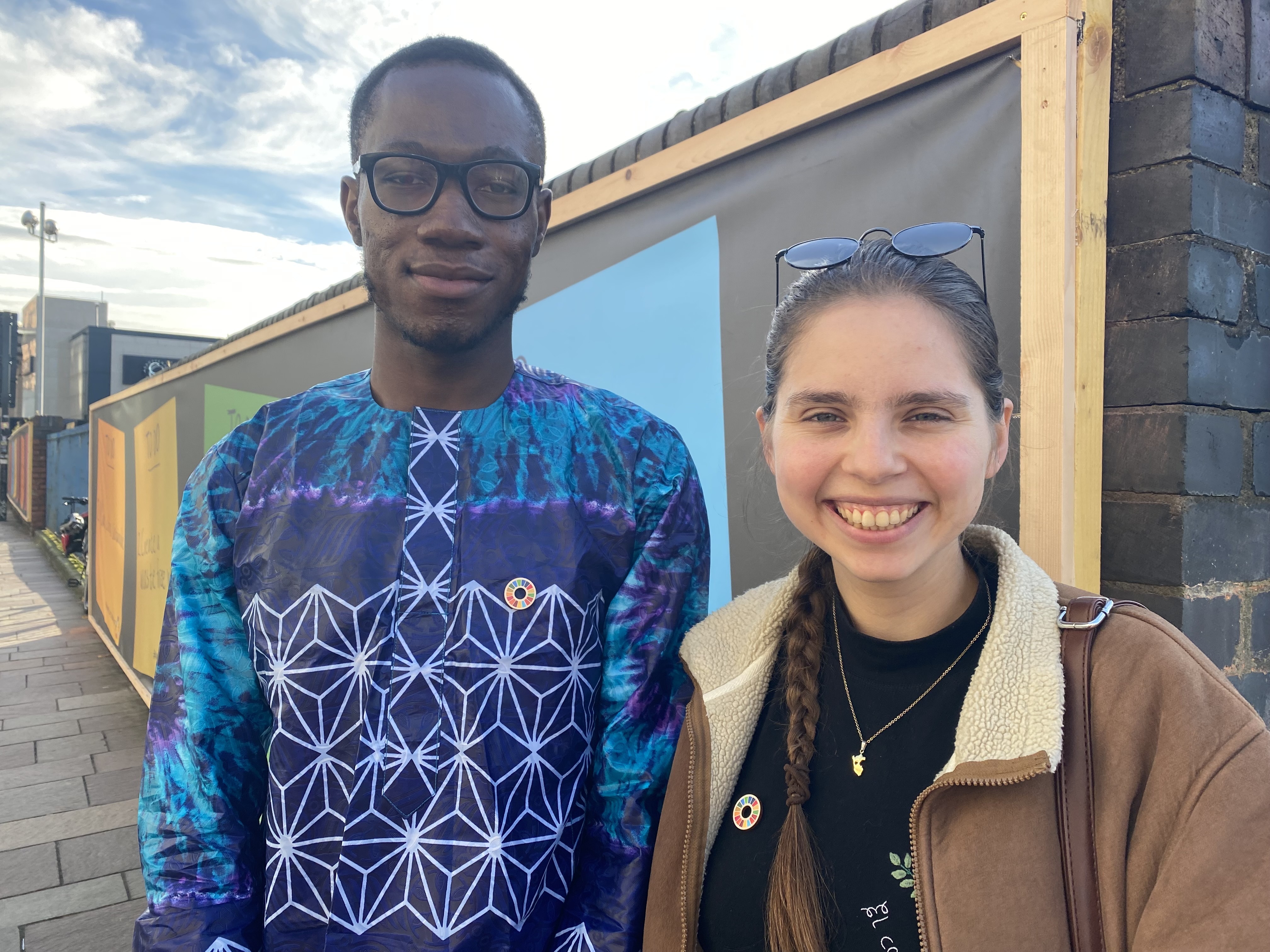
Azeri Abunakar, from Nigeria, and Inez Yabar, from Peru, tell CNN they are in Glasgow to represent the silent majority who cannot attend. They want to amplify the voices of young people who are already feeling the devastating impact of climate change.
“Me being here is a good opportunity to make sure that the voices of those not being here are being heard,” said Abunakar, who lives in Lagos, a low-lying city on Nigeria’s Atlantic coast that is increasingly vulnerable to sea level rise and flooding.
Home to more than 24 million people, Lagos may become uninhabitable by the end of this century as sea levels rise due to climate change, scientific projections suggest.
“To me it’s all about bringing here the voices of the missing majority. The people who cannot come to COP,” Yabar said of her desire to be at the summit.
Both Abunakar and Yabar have access to the main venue and say they will make sure to speak to delegates about the people they represent and experiences with climate change.
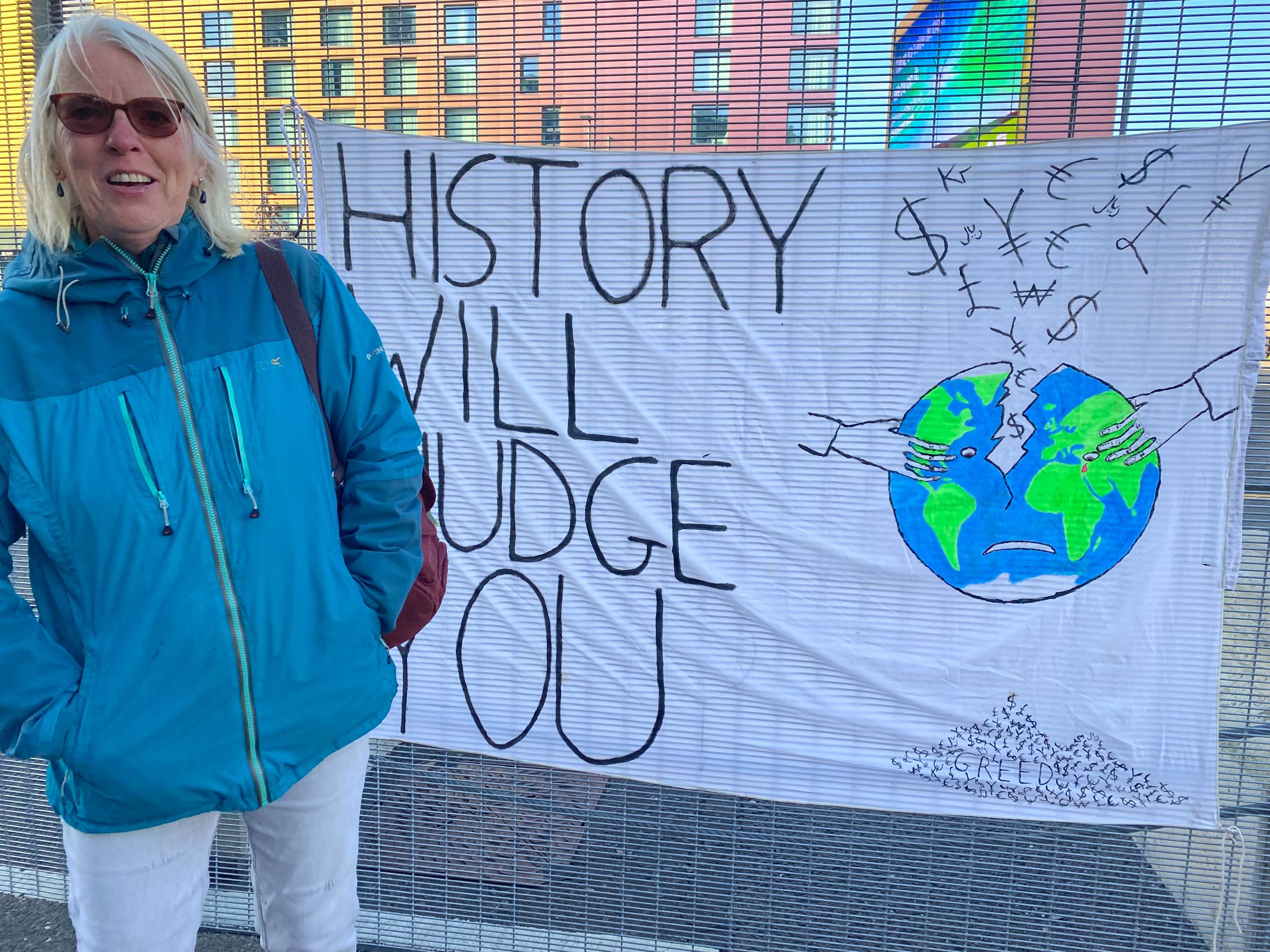
Gill Phillips, 66, from Bristol, England, came to Glasgow carrying a homemade banner that reads: “History will judge you.”
She’s not optimistic that history will judge world leaders at COP26 well.
“I think I will be disappointed. The world leaders, they are in office for five, 10 years. They care about getting re-elected, not about the long term. I’m hoping there will be some announcements. But then again, there have been announcements before and nothing happened,” Phillips said.
“We each need to do our bit. I can put my banner up, but there’s not much individuals can do. This is up to the world leaders, corporations, businesses.”
Meet the grandparents who made a pilgrimage to Glasgow
From CNN’s Ivana Kottasova
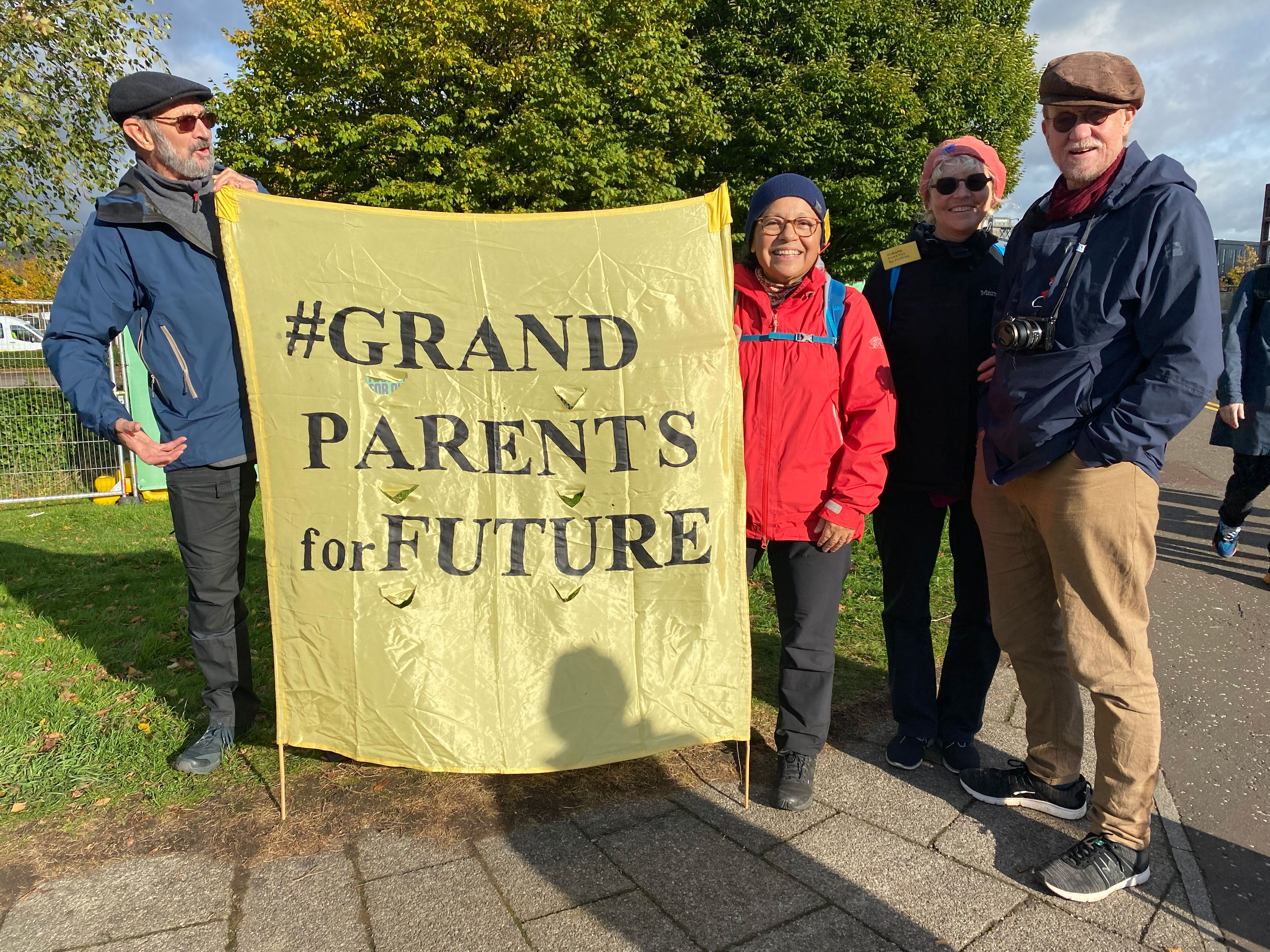
Amelia Ramirez, 67, and Sten-Ivan Bylund, 75, are two members of the “Grandparents for Future,” a Swedish group of elderly people — with or without grandchildren — who want to support young activists in their fight to stop climate change.
“We have been supporting Greta Thunberg since, well, pretty much the first day,” Bylund said.
The group took the train to Edinburgh and then spent four days walking 40 miles to Glasgow, where they are hoping to have their voices heard.
“There’s some hope … if the people there on the other side of this river [at the summit] take strong decisions, there is still hope that we can [stay] below 1.5 degrees,” Bylund said.
What steps does he want to see agreed in Glasgow?
“Stop subsidizing fossil fuel industries, start to support poor countries that are very heavily affected by climate change,” he told CNN.
Food gets an emissions label at COP26
At the COP26 summit, attendees can find out how much the food they’re buying costs and how much greenhouse gas that item has emitted.
Take a look:
“We have partnered with Swedish start up Klimato to analyse the carbon footprint of the food served at COP26,” the menu website says. “We will communicate the footprint of each dish on menu boards, informing attendees about what dishes have the lowest impact.”
Each dish is categorized by the food’s general carbon footprint: low, medium or high.